The Cost of This Job
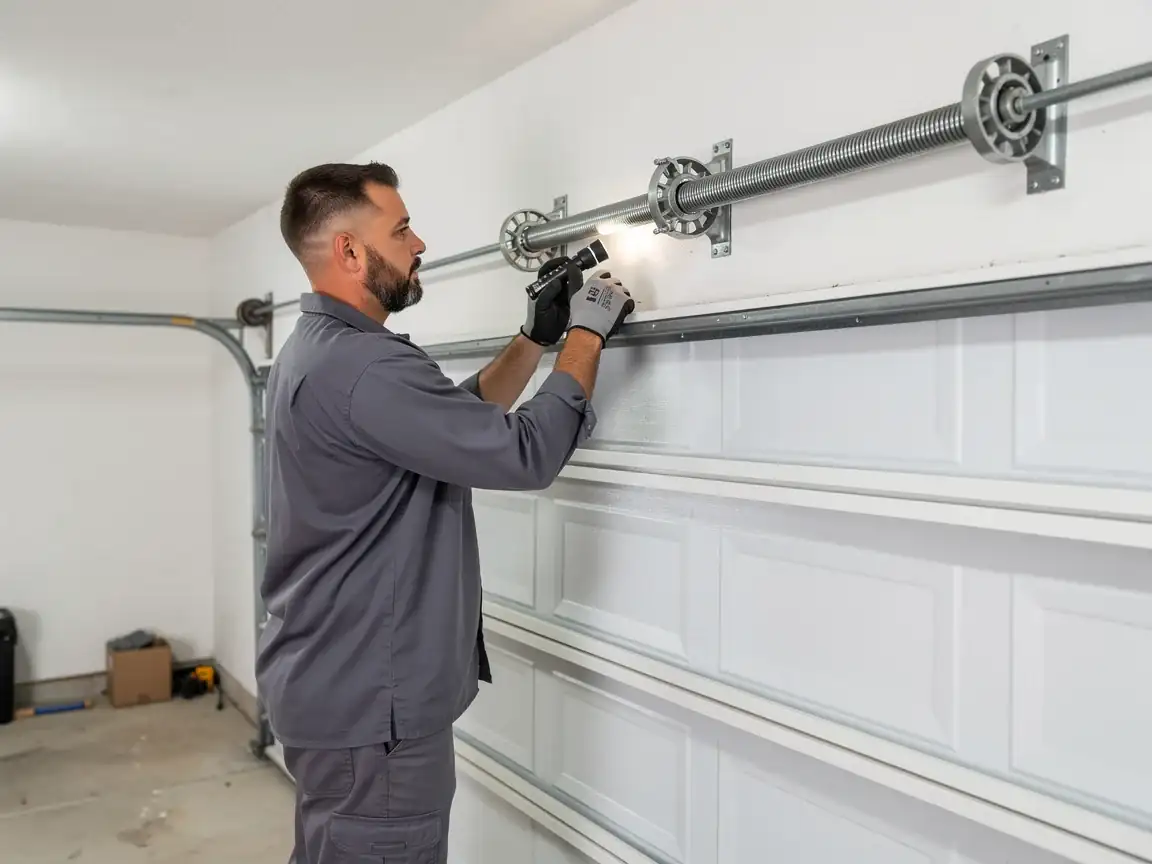
We can't give you a number without seeing the door, and anyone who quotes one over the phone is guessing. What we can tell you is what drives the cost in this area. Houses here mostly went up between 1964 and 2004, with the bulk from the 1980s and 90s spread across eight neighborhoods in the service area. A door from that window usually runs on a torsion spring system that's aged out, or an opener with a chain drive that's original to the house. Replacing a spring on a door that age is a different job than replacing the whole section, and the panel style matters too - some of these doors used steel sections that aren't stocked anymore in the exact profile. If your opener still has a manual reverse lever instead of a photo-eye safety sensor, that's a sign it predates current safety standards, and parts for it can be hard to source. We'll tell you straight if a repair is cheaper than a replacement, or if you're better off replacing the whole unit instead of chasing parts for a 30-year-old opener. With 9,549 owner-occupied houses among 18,587 households in this area, we see this exact situation often enough to know which way it usually goes.
Doing Nothing For Now
If your door is from the 1964-2004 build window and it's still opening and closing without grinding, popping, or hanging crooked, you don't need to replace it just because of its age. A lot of doors from the 1980s and 90s stock in this area are still doing fine work decades later, especially if the spring's been replaced once already. Where doing nothing gets expensive is a cable that's started to fray or a track that's visibly bent - those don't fix themselves and they tend to fail at the worst time, usually when the door's under load. One honest limitation: we don't do cosmetic panel matching for older doors. If one section is dented and the rest of the door is sun-faded a shade different from a new panel, we'll tell you that before we order the part, not after you're looking at a mismatched door.
The Situation
This area runs from Holt three miles out to Moundville seventeen miles south, with Northport, Cottondale, Coker, Coaling, Brookwood, and Vance filling in the rest of the service area. Across that spread, median household income sits at $73,292, and the housing stock skews toward that 1964-2004 build era rather than new construction or much older homes. That combination means most of the calls we get aren't about brand-new openers with smart-home quirks - they're about doors and hardware that are old enough to have outlived their original parts but not old enough to be a restoration project. Knowing the build era of a house tells us more about what's likely wrong before we even open the garage than the symptom the homeowner describes on the phone.